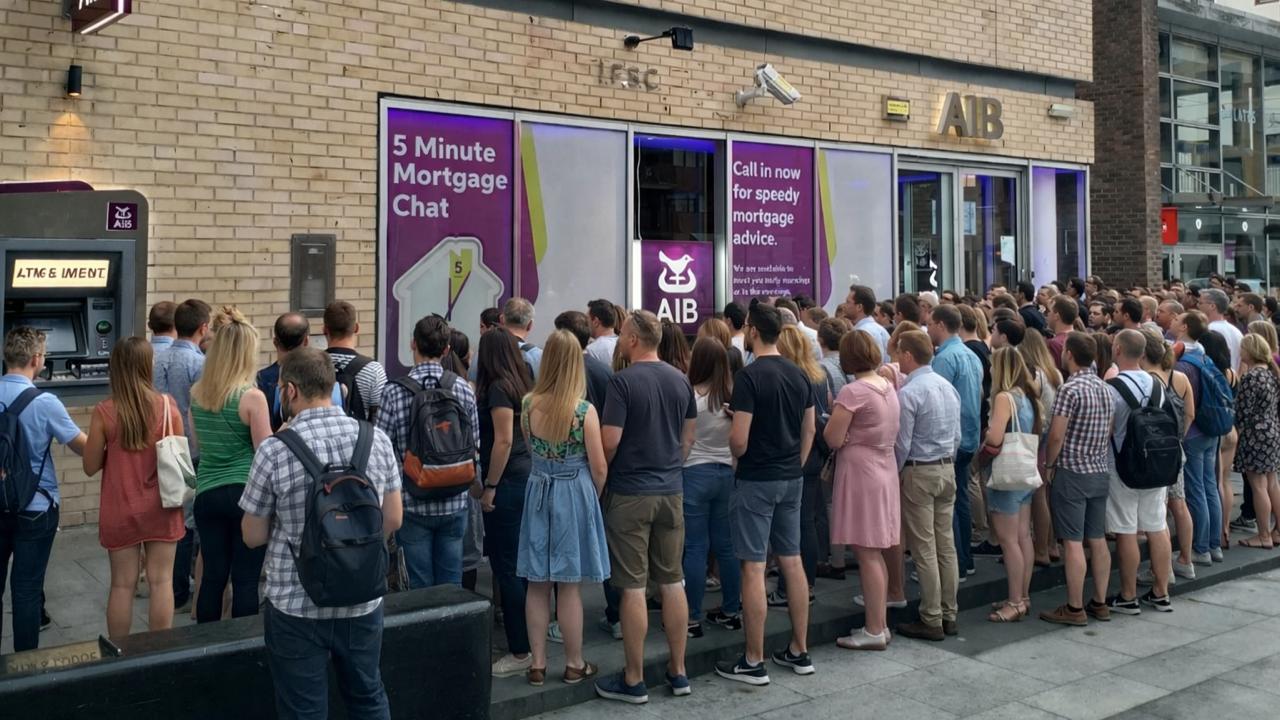
By 8:15am, the line outside a Bank of Ireland branch
on Dublin's Grafton Street already stretched
past 14 people. Most were holding paper
documents. A few were checking their phones.
Nobody looked particularly surprised.
Who Are These People and Why Are They Here?
We stopped 3 individuals in the queue and asked them
a simple question: why not do this online? The
answers were more varied than expected.
Fionnuala Byrne, a 34-year-old postgraduate student
at University College Dublin, had been waiting
for 22 minutes. She needed to certify documents
for a student loan application. The bank's app
does not support that process. She tried calling
the helpline the previous day and waited 38
minutes before hanging up.
Declan Ó Treasaigh, 61, was there to close a joint
account following a family bereavement. He said
the branch told him this could only be done in
person, with original paperwork. He arrived at
8:40am and estimated he was number 9 in the
queue.
The third person, a 19-year-old first-year student
named Aoife Dunleavy, needed to update her
address for a student account. She had tried the
online portal 4 times over 6 days. Each attempt
ended with an error message.
Digital Services vs. In-Person Needs
What connects all 3 cases is the same pattern: tasks
that appear simple but fall outside what digital
banking currently handles. Ireland has seen a
31% reduction in bank branches since 2016,
according to figures cited by the Banking and
Payments Federation Ireland. Fewer branches
handling the same volume of complex, in-person
requests means longer waits for everyone.
For students managing finances for the first time,
this is a practical lesson in how infrastructure
gaps translate into real-time costs. A 45-minute
queue on a Tuesday morning is not just
inconvenient. It is a gap in the system that no
app has filled yet.